
 011 568 3336 / 011 568 3423
Why investing still matters – even when fear feels too familiar
By Eugene Visagie, Director and Head of Strategy
April 2026
During periods of geopolitical tension, such as the current conflict in the Middle East, investor anxiety naturally heightens. Rising fears around oil prices, diesel shortages, fertiliser supply risks, and broader economic uncertainty can make it feel counterintuitive to remain invested. It feels more like a reminder to stockpile and keep your spare cash underneath a mattress. History has consistently shown that staying the course during turbulent times can be one of the most powerful long‑term investment strategies. It has also been proven that we won’t actually run out of hand sanitiser and toilet paper…
Understanding investor behaviour becomes especially important during these periods. Emotional reactions often lead to hasty decisions such as panic buying, panic‑selling, over‑trading, or making sudden shifts in risk exposure. Behavioural finance shows that these instinctive responses are rarely beneficial and that maintaining discipline helps investors avoid costly mistakes. Research highlights that markets often recover after initial wartime sell‑offs, with investors returning their focus on fundamentals once uncertainty stabilises.
What history tells us about markets in times of war
While no two conflicts are identical, history offers valuable lessons. Over more than a century of data, global markets (particularly in the US) have often delivered strong returns during wartime, despite short-term volatility. In many conflicts, equities initially fall as fear spikes, but markets frequently reassess and recover as conditions become clearer.
When we examine past market behaviour, the evidence overwhelmingly shows that financial markets often performed well during wartime. During World War II, US large‑cap stocks generated an annualised return of 16.9% per year over the six years[1]. This means an investment of R100 at the start of the war would have grown to approximately R255 by the end, which is a total return of 255%. On a sector level, printing and publishing delivered an exceptional 926% return, while the beer and liquor sector followed with 723%. A R100 investment would have grown to R926 in printing and publishing, and R723 in beer and liquor.
Even the worst‑performing sectors during the war delivered positive returns – for example, tobacco products returning +55% and communication +60%.
Exhibit 1 | US stock market returns ten years after a war was started
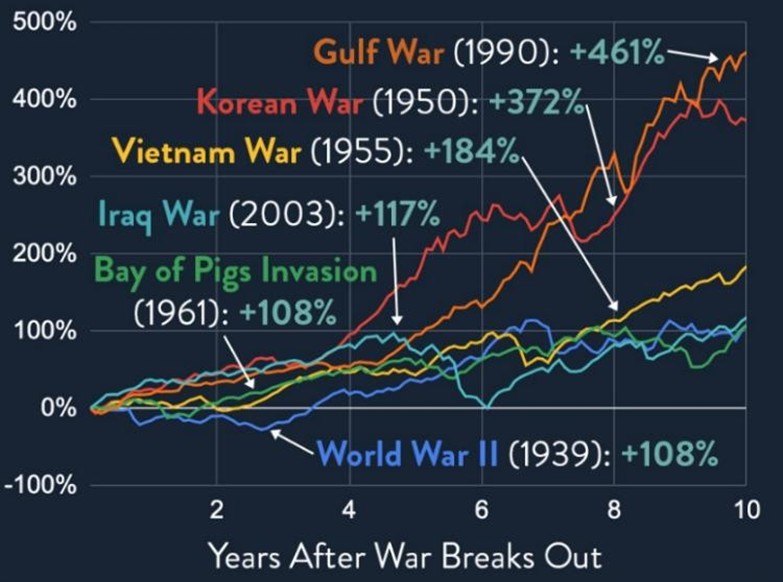
Source: Personal Finance Club, “How does war affect the stock market?” Published 4 March 2026. For illustrative purposes only.
More recently, during the Gulf War, US large‑cap stocks produced positive results and delivered an 11.7% return for the duration of the conflict. Overall, historical market data illustrate a consistent pattern: US equity markets tend to rise – not fall – during periods of war.
Modern analyses also show that countries not directly involved in a conflict, or those supplying goods to the war effort, often experience economic and market resilience. This reflects shifting demand patterns and global reallocations of resources.
Importantly, sectors can perform differently during conflict, with some industries benefiting from changes in consumption, production, and government spending. While individual sector performance varies, wartime market trends generally support the case for remaining invested rather than retreating to cash.
What about South Africa
South Africa has historically shown resilience during global conflicts. During World War II, it experienced a surge in domestic manufacturing and substantial government expenditure, both of which helped stimulate economic activity despite the global turmoil. Although detailed JSE data for that period is not available, the economic environment suggests a supportive backdrop for South African companies.
Looking at broader emerging markets, namely Brazil, India, China, and Southeast Asia, we see that markets typically fall at the outbreak of war but tend to recover within months if the conflict remains geographically contained. This pattern aligns with global evidence showing that initial wartime declines are often followed by stabilisation as uncertainty clears.
Today, several dynamics may work in South Africa’s favour:
- Recent disruptions in Qatar’s Liquefied Natural Gas (LNG) export capacity have pushed Asian buyers toward alternative energy sources (including coal), potentially supporting South African exports.
Shipping reroutes due to regional conflict have brought more vessels around South Africa’s coastline, contributing to increased port activity as local port operations continue to recover.
These are not guarantees, but they illustrate how global shocks can sometimes create unexpected tailwinds for countries positioned to fill emerging supply gaps.
The next ten years will not look exactly like the past, and they shouldn’t.
Every era is unique, and history gives us a clear guide: investors who stay disciplined, stay invested, and stay focused for the long term have historically been rewarded, even when the world appears at its most uncertain.
Market turbulence will always be part of the journey. The key is not to fear it but to navigate it with perspective, patience, and a sound investment plan.
One powerful aspect to recognise is that the fear can feel familiar. During COVID-19, empty shelves convinced many that shortages would persist, yet they didn’t. Supply chains adapted, shelves were restocked, and life normalised far sooner than many expected.
While war is far more complex and consequential, the behavioural response it triggers can feel strikingly similar. The same instinct to retreat, to hoard, and to act defensively begins to take hold. For investors, recognising this pattern is powerful. Because just as fear once overstated the permanence of shortages, it can just as easily overstate the permanence of market declines.
Remaining invested is not about dismissing risk; it is about seeing through the noise, understanding our instincts, and trusting that periods of disruption, however intense, are rarely permanent.
[1] Source: Ibbotson Associates; Stocks, Bonds, Bills, and Inflation (SBBI Yearbook). For illustrative purposes only.
Additional sources:
Dailymaverick.co.za, “Potential silver linings for S.A. in a cloud of war over Middle East”. Published 29 March 2026.
Investopedia.com, “The impact of war on the stock markets – what investors need to know”. Published 3 March 2026.
Disclaimer
Although reasonable steps have been taken to ensure the validity and accuracy of the information in this document, Optimum Investment Group (OIG) does not accept any responsibility for any claim, damages, loss or expense, however, it arises, out of or in connection with the information in this document, whether by a client, investor or intermediary.
Optimum Investment Group (Pty) Ltd. Is an Authorised Financial Services Provider (43488).
All investments involve risk, including the potential loss of principal. There is no assurance that any financial strategy will be successful. OIG does not guarantee that the results of any advice, recommendations, or strategies will be achieved. Before making any investment decisions, customers should thoroughly review all relevant investment product documents and information. It is essential to assess whether an investment aligns with your financial situation, objectives, and risk profile.
This document may contain forward-looking statements identified by terms such as “expects,” “anticipates,” “believes,” “estimates,” “forecasts,” and similar expressions. These statements involve risks, uncertainties, and other factors that could cause actual results to differ materially from those projected. OIG is not responsible for any trading decisions, damages, or other losses resulting from the use of the information, data, analyses, or opinions provided.
Past performance does not guarantee future results. Neither diversification nor asset allocation ensures a profit or protects against a loss.
The information, data, analyses, and opinions presented herein are for informational purposes only and do not constitute investment advice or an offer to buy or sell any security. References to specific securities or investment options should not be considered an offer to purchase or sell those investments. The performance data shown reflects past performance and is not indicative of future results.
The opinions expressed are those of OIG as of the date written, are subject to change without notice, and do not constitute investment advice.